Far-UVC
Far-UVC in the Electromagnetic Spectrum
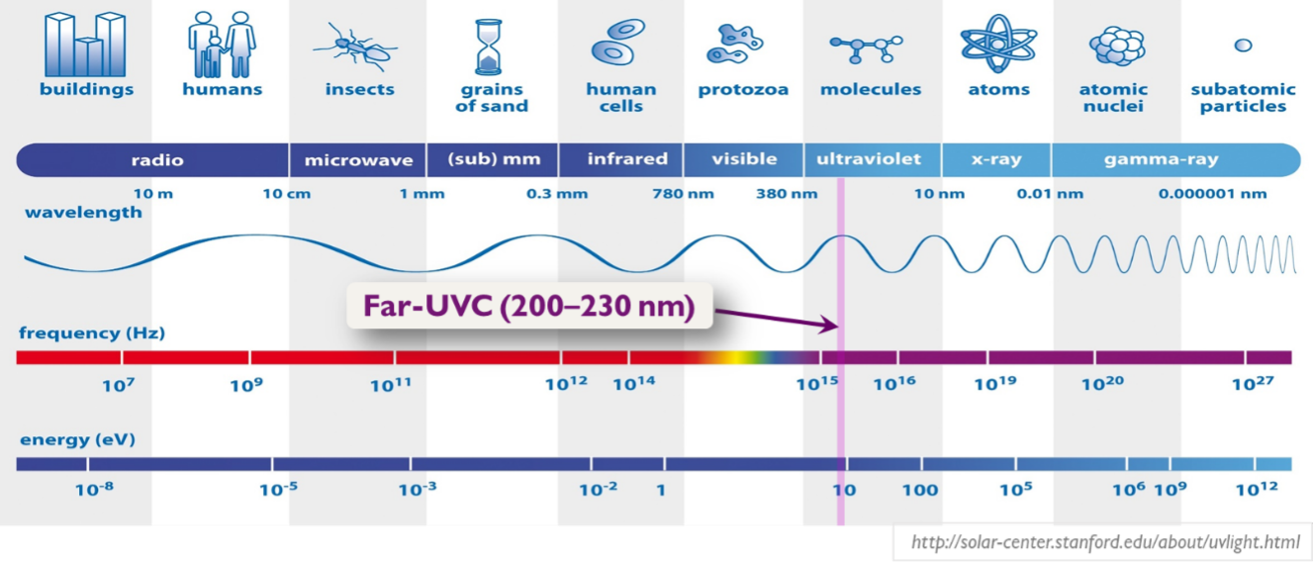
The electromagnetic spectrum spans from low-energy radio waves to high-energy gamma rays. Visible light sits in the middle, followed by higher-energy ultraviolet light. Remember: shorter waves mean higher energy.
The Electromagnetic Spectrum
1. Understanding the UV Spectrum
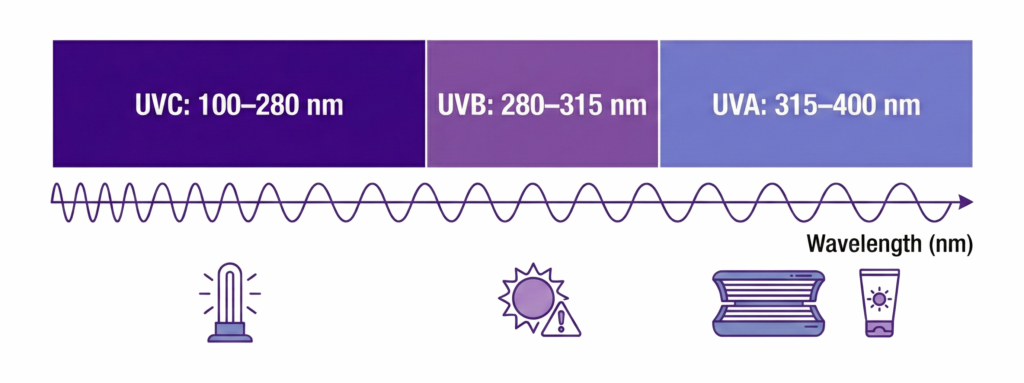
The ultraviolet (UV) spectrum is conventionally divided into three specific regions defined by wavelength (measured in nanometers or nm):
- UVA: 315–400 nm
- UVA: 280–315 nm
- UVA: 100–280 nm
2. The "Sweet Spot": Far-UVC (200–230 nm)
Located in the middle of the UVC band, Far-UVC is distinct from the regions surrounding it because of its unique safety profile:
- VS. Vacuum/Deep UV (<200 nm): Wavelengths shorter than Far-UVC are effectively absorbed by oxygen and nitrogen in the air, limiting their reach.
- VS. Conventional UVC (>230 nm): While effective for disinfection, conventional UVC is widely acknowledged as unsafe for human exposure.
The Far-UVC Advantage:
At sufficiently high output, Far-UVC is highly effective for disinfection while remaining SAFE for human exposure.
3. Current Industry Limitations
Until now, the industry has struggled to produce efficient Far-UVC light.
Option A: Excimer Lamps (The Current Standard) Krypton-chlorine (KrCl*) excimer lamps are currently the only commercially viable option, but they face significant adoption hurdles:
- Inefficient Output: They emit unwanted sideband peaks that require optical filters to attenuate.
- Low Performance: Their output falls short of the full promise of Far-UVC.
- High Cost: The technology remains expensive to manufacture.
Option B: LED Technology (The Distant Future) Research into using LEDs to replace mercury vapor lamps is active but immature:
- Material Challenges: Requires aluminum nitride, a notoriously difficult semiconductor substrate.
- Timeline: Practical realization is likely 10–15 years away.
4. The Breakthrough: SaniLux
SaniLux leverages nanoengineered materials to overcome the limitations of excimer lamps. By emitting at a peak of 216 nm, SaniLux delivers a massive leap in performance and economic viability.
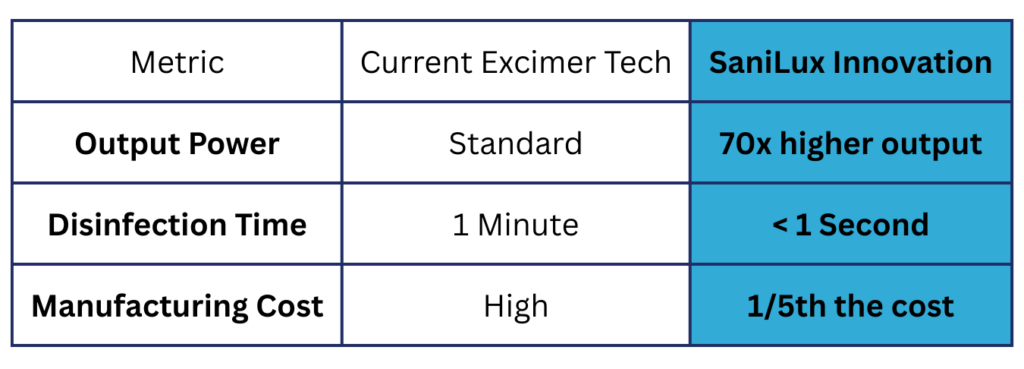
Conclusion: Despite the demand created by COVID-19, excimer adoption has been slow due to cost and performance issues. SaniLux solves both, unlocking the true future of safe air and surface disinfection.
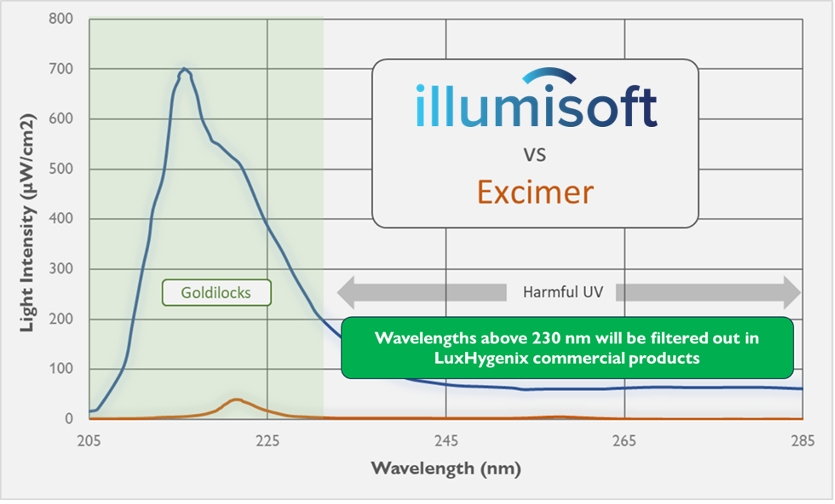
Recent performance data comparing output of LuxHygenix pre-production units with peak at 216 nm to that of a commercial excimer lamp (peak emission at 222 nm; optically filtered).
The Safety Difference: Conventional vs. Far-UVC
While both technologies effectively neutralize viruses and bacteria, they differ fundamentally in how they interact with human tissue.
1. Conventional UV (254 nm):
- The Source: Uses standard mercury vapor lamps.
- The Mechanism: Destructively acts on the DNA of all organisms.
- The Problem: Because it penetrates human skin and eyes, it causes damage to healthy tissue.
- Operational Limit: It is unacceptable for use in the presence of people, meaning disinfection can only happen when rooms are empty.
2. The Far-UVC Advantage
- The Source: Shorter wavelengths than conventional UV.
- The Benefit: Offers the same pathogen-neutralizing power as conventional UV but does not penetrate healthy human tissue.
- The Game Changer: Far-UVC is the only technology that enables continuous decontamination in occupied spaces.
The Science of Safety
Why is Far-UVC safe when conventional UV isn’t?
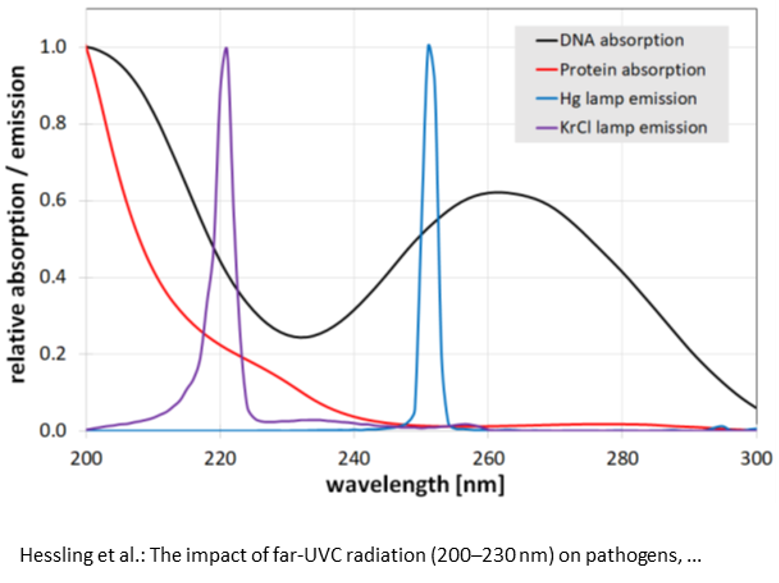
- Skin Attenuation: While conventional UV reaches living cells, Far-UVC wavelengths are "attenuated" (stopped) by the non-living outer layers of human skin and eyes before they can reach or damage DNA.
- Protein Targeting: Far-UVC has a unique dual-action mechanism. In addition to targeting DNA, it is preferentially absorbed by peptide bonds in proteins, providing a secondary mechanism that increases its antimicrobial efficacy.